
The proposed arrangement would involve sub-assembly kits produced at Lockheed Martin's facility in Troy, Alabama, and guidance electronics units manufactured at Raytheon's facility in Tucson, Arizona, being shipped to India for final assembly and integration.

However, longer range missiles, under-sea launched missiles and futuristic weapons systems like electronic counter-warfare measures will be 'undertaken in-house,' said Dr S Prahlada, one of country's top defence scientists.
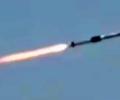
The trails were conducted without a helicopter in direct and top attack mode.

The Defence Research and Development Organisation (DRDO) and the Indian Air Force (IAF) have successfully conducted flight tests of the RudraM-II air-to-surface missile, marking a significant milestone in indigenous defence technology.

India has successfully conducted the maiden salvo launch of the indigenously developed Naval Anti-Ship Missile-Short Range.

TARA is India's first indigenous modular glide weapon, capable of transforming conventional unguided warheads into long-range precision-guided weapons.

Lt Gen NS Raja Subramani (retd) has been appointed as India's next Chief of Defence Staff, succeeding Gen Anil Chauhan. Vice Admiral Krishna Swaminathan has been named the next Chief of the Naval Staff, succeeding Admiral Dinesh K Tripathi. Lt Gen Subramani's primary mandate will be to implement the military theaterisation plan and bolster tri-services synergy.
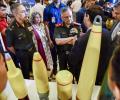
'General Subramani's appointment as military adviser in the NSCS has given him insight into decision-making at the apex level prior to formally taking over as CDS.'

Lieutenant General Seth's involvement in the army's capability development and modernisation efforts is evident from the key appointments he has held in the Strategic Planning and Capability Development Directorates, including Colonel Capability Development for Mechanised Forces, Brigadier Perspective Plans and Acquisition, and Additional Director General Capability Development.

The Trishakti Corps Infantry and Mechanised Infantry Battalion conducted a training exercise for its Anti Tank Guided Missile at a super-high altitude of 17,000 feet in Sikkim on Thursday, April 11, 2024.

While the Andaman and Nicobar islands serve as a vital, stationary asset for projecting power in the Indian Ocean, referring to them as an unsinkable aircraft carrier ignores key military and geopolitical limitations, explains Commodore Venugopal Menon (retd).
Two medium-range surface-to-air missiles 'Akash' were successfully test-fired from the Integrated Test Range (ITR) at Chandipur-on-sea, about 15 km from Balasore.

Vayu Shakti-2026 showcased the Indian Air Force's readiness for combat operations in both day and night conditions.

The IAF's future operational concepts could involve indigenous Tejas combat aircraft coordinating in real time with multiple Ghatak RPSAs, each carrying a different mission payload ranging from electronic warfare systems and targeting sensors to precision munitions.

India on Thursday test-fired its nuclear-capable Prithvi-II ballistic missile with a strike range of 350 km from a test range near Balasore as part of a user trial by the army.
India's long-criticised Akash anti-aircraft missile is now blazing towards success. After years of rejection from the military, the Akash is being accepted as a world-class missile.

Glimpses from Vayu Shakti 2026 highlight India's aerial might and combat readiness. From sonic booms to precision strikes, the Indian Air Force showcased its full-spectrum capabilities over Rajasthan skies.

The largest tranche came in July, in the wake of Operation Sindoor, with the DAC according acceptance of necessity -- or initial approval -- for 10 capital acquisition proposals amounting to approximately 1.05 trillion through indigenous sourcing.

The Defence Acquisition Council (DAC) has approved procurement of long range rockets, missiles, radar systems and military platforms worth Rs 79,000 crore to bolster the military's combat prowess.

'The heat shield technology for re-entry vehicles was first mastered in DRDO for the Agni missile.' 'This is why the Americans were so opposed to Agni in the 1980s, unlike other missiles -- it was a re-entry vehicle.'
Defence Research and Development Organisation Director General Vijay Kumar Saraswat on Friday said the Agni-V missile, which took 30 years to be developed, was the best such thing in the 21st century. Agni-V is an intercontinental ballistic missile developed by the DRDO. It is part of the Agni series of missiles, one of the missile systems under the original Integrated Guided Missile Development Programme.

India has approved proposals to procure weapons and military hardware worth Rs 79,000 crore, including Nag missiles, amphibious warfare ships, and electronic intelligence systems, to enhance the military's combat capabilities.
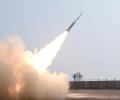
The Integrated Test Range of Defence Research and Development Organisation (DRDO) has taken various measures to protect its facilities at Chandipur and Abdul Kalam Island in Odisha, which are likely to be affected by cyclone 'Yaas', an official said.

In fresh trials, India has test-fired its indigenously developed Nag anti-tank guided missile, which can hit a target up to seven km, from a helicopter at a firing range in Jaisalmer in Rajasthan.
The Indian Army in the intervening night of May 8 and May 9 successfully repelled and responded to multiple drone attacks by Pakistan along the western border and the Line of Control (LoC) in Jammu and Kashmir.

The surface-to-surface missile, a naval variant of the indigenously-developed 'Prithvi' missile, was test-fired from the ship positioned near Paradip in the Bay of Bengal at around 10.52 am, the officials said.

The Indian military will showcase an Operation Sindoor-themed tableau for the Republic Day parade, highlighting the jointness of the three services and India's military capabilities.
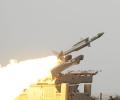
The missile targeted a floating object supported by the pilot-less target aircraft 'Lakshya', defence officials said.

The Defence Acquisition Council (DAC) has recently approved procurement proposals worth Rs 79,000 crore across three services and it has cleared AoN (Acceptance of Necessity) of Rs 3.3 trillion in financial year 2026 (FY26).

The Prithvi-II missile is capable of carrying 500 kg to 1,000 kg of warheads and is thrusted by liquid propulsion twin engines.
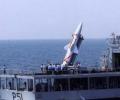
India on Thursday successfully test-fired its nuclear-capable Dhanush ballistic missile with a strike range of 350 km

India on Monday successfully test-fired its indigenously developed nuclear capable Prithvi-II missile, which has a strike range of 350 km, as part of a user trial for the defence forces.

The missile is capable of carrying 500/100 kg of warheads and is powered by liquid propulsion twin engines.
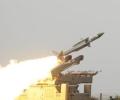
India today successfully test fired indigenously-developed surface-to-air Akash missile with a strike range of 25 km and capability to carry warhead of 60 kg from the Integrated Test Range at Chandipur as part of a user-trial.

India's Navy has commissioned its new Russian-made guided missile frigate, INS Tushil, in the Russian coastal city of Kaliningrad. The ship, part of a $2.5 billion deal for four stealth frigates, is expected to significantly enhance the Indian Navy's capabilities in the Indian Ocean. The commissioning ceremony was attended by Defence Minister Rajnath Singh, Chief of Naval Staff Admiral Dinesh K Tripathi, and other senior Indian officials. Singh described the commissioning as a testament to India's growing maritime strength and a milestone in its long-standing ties with Russia. The INS Tushil, an upgraded Krivak III class frigate of Project 1135.6, boasts advanced stealth features and stability characteristics, and incorporates 26% indigenous content thanks to collaboration with Indian naval specialists and Severnoye Design Bureau.
The missiles were randomly chosen from the production stock and the entire launch activities were carried out by the specially formed strategic force command and monitored by the scientists of Defence Research and Development Organisation as part of training exercise, a defence scientist said.

Prithvi-II is capable of carrying 500-1,000 kilogram of warheads and is thrusted by liquid propulsion twin engines.

India on Saturday successfully conducted two rounds of trials of its indigenously developed surface-to-air Akash missile as part of a user trial by the Indian Air Force from the Integrated Test Range at Chandipur near Balasore in Odisha.

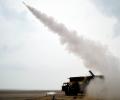
The missile test was carried out from a mobile launcher from launch complex-3 of the Integrated Test Range at about 10 am, defence officials said.
